Quick answer: count the wheel's mounting holes or the hub's studs first. For a 4-, 6- or 8-lug pattern, measure from the center of one hole or stud straight across to the center of the opposite one. For a 5-lug pattern, measure from the center of one hole or stud to the outer edge of the farthest one. Write both numbers together, such as 5x114.3.
A wheel bolt pattern is easy to overlook because it is not the part you see once the wheel is on the car. It is also non-negotiable. If the wheel and hub do not share the correct pattern, the wheel cannot mount correctly, regardless of how good the design, finish or offset may look on paper.
The good news is that bolt-pattern measurement is straightforward when you use the right reference points. The measurement tells you how many wheel studs or bolt holes the vehicle uses, and the diameter of the circle that runs through their centers. Knowing it gives you a reliable starting point for comparing wheels, but it should always be followed by the rest of the fitment conversation: center bore, hardware, brake clearance, width, offset, tire size and how the car will be used.
What a wheel bolt pattern means
A bolt pattern is normally written with two numbers separated by an x. A pattern listed as 5x114.3 has five mounting holes arranged on a 114.3 mm circle. You may also hear that circle called a bolt circle, pitch circle diameter or PCD. The first number is the lug count. The second is the diameter of the imaginary circle that passes through the center of every mounting hole.
The format is simple, but it prevents a common mistake: counting the lugs without checking the circle size. Many vehicles use five-lug wheels, for example, but five lugs does not mean every five-lug wheel fits every five-lug hub. A 5x112 wheel, a 5x114.3 wheel and a 5x120 wheel all have five holes, yet the holes sit on different circle diameters.
Tire Rack’s bolt-pattern measurement guide uses the same core approach: identify the lug count first, then measure the bolt circle through the center of the holes. It is a useful check when you are comparing a wheel listing with the car in front of you.
What you need before you measure
For the cleanest result, remove the wheel and place it on a protected surface. You can measure a wheel or a hub, since the relevant reference points are the centers of the mounting holes or studs. A tape measure with millimeter markings is helpful. A ruler, a straightedge and a simple calculator make it easier to keep the measurements honest.
Before measuring anything, look for a stamped or cast specification on the back of the wheel. Many wheels list a pattern such as 5x120 or 6x139.7 near the hub mounting pad. Treat that marking as a useful clue, not a substitute for verifying an unknown wheel. Wheels can be refinished, repaired or sold without a clear history, and a quick measurement is cheaper than discovering a mismatch after tires are mounted.
It also helps to write down the vehicle details while you are there: year, make, model, trim, brake changes, suspension changes and planned tire size. The bolt pattern answers only whether the wheel can line up at the hub. Those other details decide whether the finished wheel and tire package will clear, drive properly and look at home on the vehicle.
Measure the pattern step by step
1. Count every mounting hole or stud
Start by counting the holes in the wheel or the studs on the hub. That count is always the first part of the bolt-pattern label. A five-lug pattern begins with 5. A six-lug pattern begins with 6. Count the mounting points, not the decorative openings in the wheel face, and make sure no wheel cover or center cap is hiding part of the mounting area.
2. Find the center of the reference points
The measurement must run through the center of each hole or stud. On a wheel, look at the circular opening itself, not the tapered edge where the lug seat begins. On a hub, use the center of the stud. Taking a second to establish those points is more reliable than stretching a tape between whatever edges are easiest to reach.
3. Use the correct method for the lug count
For four-, six- and eight-lug patterns, measure center to center across the hub. For a five-lug pattern, measure from the center of one hole or stud to the outside edge of the farthest one. The different method is necessary because an odd number of lugs does not place a hole directly across from the one where you begin.
4. Record the complete measurement
Write down the lug count and bolt-circle diameter together, preferably in millimeters. A note that says only “five lug” will not help you compare wheel options later. A note that says “5x114.3” gives the actual mounting pattern. Keep it with the vehicle details, then use it as the first check when looking at a wheel design.
How to measure a 4-, 6- or 8-lug bolt pattern
Even-number bolt patterns are the easiest to measure because there is always a hole or stud directly across from the one where you begin. Count the lugs, then measure from the center of one hole straight across to the center of the opposite hole. That distance is the bolt-circle diameter.
For a four-lug wheel, measure from one hole to the hole directly opposite it. The same method works for six-lug and eight-lug wheels. Keep the tape centered on the holes or studs rather than measuring from an edge. A measurement taken outside-to-outside or inside-to-inside can look close enough at a glance while still producing the wrong result.
Write the result in millimeters whenever possible. Some older wheel listings use inches, which is where confusion begins. A 4.5-inch bolt circle is 114.3 mm, and a 5.5-inch bolt circle is 139.7 mm. Converting an exact measurement is fine. Guessing from a tape that falls between markings is not.
How to measure a 5-lug bolt pattern
Five-lug wheels need a slightly different approach because there is no mounting hole directly opposite your starting point. Instead, measure from the center of one hole to the outer edge of the hole farthest away from it. That gives you the diameter of the bolt circle for the common five-lug pattern.
The detail that matters is where the tape ends. Start at the center of one hole. Move diagonally across the wheel to the farthest hole, then measure to that hole’s outside edge, not its center. On a wheel, this is usually easier to see with the wheel removed. On a hub with studs, measure from the center of one stud to the outer edge of the farthest stud.
Another dependable option is to use the vehicle’s documented factory specification as a cross-check after measuring. KMC Wheels’ bolt-pattern explanation makes the important point clearly: the pattern includes both the number of lugs and the diameter of the circle they form. A five-lug count alone is not a complete specification.
If the result seems close to a familiar size, slow down rather than rounding it into place. Several five-lug patterns are only a few millimeters apart. Those differences are enough to prevent a wheel from seating correctly, and forcing the hardware to make something fit can damage the wheel, studs or mounting surfaces.
Common bolt patterns and why similar is not the same
Some patterns appear often across performance cars, trucks and SUVs. Examples include 5x112, 5x114.3, 5x120, 5x127, 6x135 and 6x139.7. Seeing a familiar number can be helpful when you are confirming a measurement, but it is not a reason to assume compatibility. Vehicle manufacturers can use different patterns across trims, model years and platforms that look nearly identical from the outside.
The 5x114.3 and 5x4.5 naming example causes regular confusion. They describe the same bolt-circle diameter in metric and inch units. That is a unit conversion, not a second pattern. By contrast, 5x112 and 5x114.3 are different patterns, even though the measurements look close. A wheel should never depend on hardware being pulled sideways or holes being elongated to compensate for a mismatch.
Truck fitment deserves the same discipline. A wheel that shares a six-lug pattern with a truck may still be wrong for its load requirements, brake package, tire size or intended use. Before choosing a truck wheel, use REVO’s forged truck wheels guide to think through tire direction, ride height and clearance with the actual job of the truck in mind.
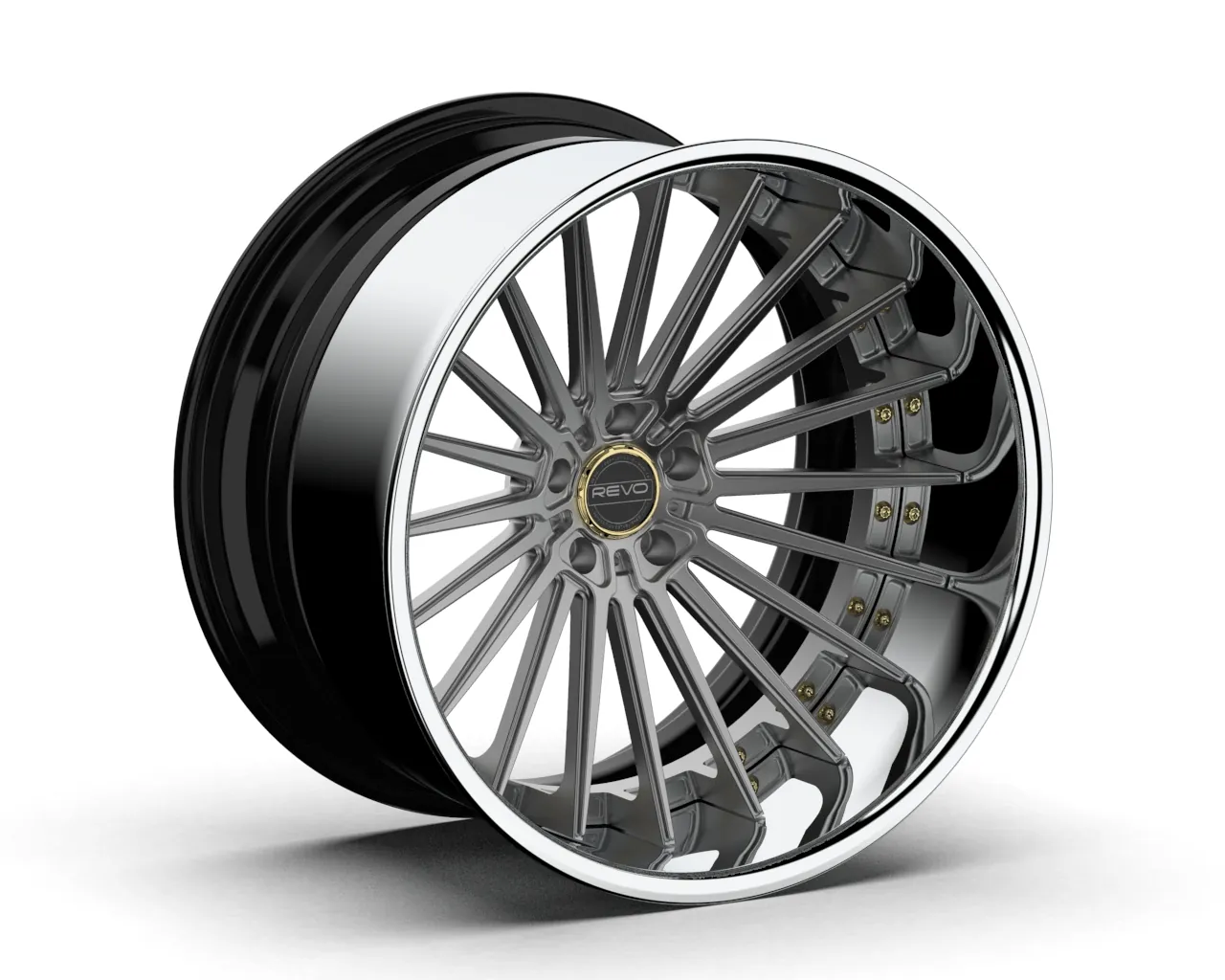
A matching bolt pattern is only the start
A correct bolt pattern allows the wheel to line up with the hub. It does not confirm that the wheel is the right fit. The center bore needs to work with the vehicle hub. The mounting pad and lug-seat style need to suit the proper hardware. The wheel face needs to clear the brakes. Width, offset and tire size need to leave room at the suspension, fender and steering lock.
This is where a wheel that looks correct in a listing can still become a problem. A wheel can have the right 5x114.3 pattern but the wrong center bore. It can have the right center bore and pattern but lack room for a big-brake caliper. It can mount over the hub and still sit too far inward near a coilover or too far outward near the fender. Each condition needs its own check.
Start by comparing the bolt pattern, then move to center bore and hardware. After that, use the actual width and offset rather than copying a number from another build. REVO’s wheel offset measurement guide explains how those dimensions affect where the wheel sits, while the wheel offset chart makes it easier to compare changes before committing to a new setup.
Do not use the bolt pattern to guess at adapters or spacers
Spacers and adapters can be useful in specific, properly engineered applications, but they should never be a shortcut around an uncertain measurement. A spacer moves the wheel outward and changes the effective offset. An adapter can add a separate mounting interface and, in some cases, change the pattern between the vehicle and wheel. Both decisions affect hub engagement, hardware length, brake clearance and the load path through the assembly.
That is why a bolt-pattern match should lead to more questions, not fewer. If a wheel only works with an adapter, the car still needs to be assessed around the exact adapter, wheel, tire and intended use. A solution that looks tidy while parked can create clearance or service issues once the car is turning, loaded or moving through suspension travel.
For a straightforward street build, the most dependable choice is usually a wheel designed around the car’s original mounting pattern and full fitment requirements. For a complicated custom build, the details should be resolved before production, when there is still room to choose the right face, barrel, width and offset instead of asking an adapter to rescue a compromise.
A measurement checklist before ordering wheels
Use this list to keep a wheel search grounded in the details that matter. First, confirm the vehicle’s exact year, make, model and trim. Second, confirm the bolt pattern by reliable documentation and, when possible, a measurement of the actual hub or wheel. Third, record the center bore and the hardware style the vehicle uses.
Next, note any brake upgrades, coilovers, air suspension, lowering springs, fender changes or wider tires. These are not side notes. They change the room available for the wheel and tire package. Finally, decide how the vehicle will be used. A show-focused car, a hard-driven street car, a track car and a truck that carries or tows do not ask the same things of a wheel.
The more complete this starting information is, the less likely a custom order becomes a collection of last-minute adjustments. You can also compare the engineering tradeoffs between designs in REVO’s three-piece versus one-piece wheel guide before deciding which construction gives your build the freedom it needs.
How REVO approaches bolt pattern and fitment
REVO begins with the vehicle, not a generic wheel size. Bolt pattern is part of that starting point, alongside the hubs, brakes, suspension, tire plan, intended use and the visual direction you want from the finished set. Those details make it possible to plan the center, face profile, barrel, width and offset as one wheel specification.
Browse the REVO wheel collection to find a design direction, then look through the construction options to see how a one-piece, two-piece or three-piece set can be tailored around the build. When you are ready, send the exact vehicle details through the fitment quote form. A clear starting brief turns a basic bolt-pattern measurement into a wheel package that is made to mount, clear and belong on the car.
Frequently asked questions
Can I measure a bolt pattern with the wheel still on the car?
You can often identify the pattern with the wheel installed if the lug hardware is visible, but removing the wheel gives you a cleaner view and a more dependable measurement. It also lets you inspect the mounting face, center bore and hardware before you make a decision.
Is 5x114.3 the same as 5x4.5?
They are very close, but they are not the same measurement. A 4.5-inch bolt circle converts to 114.3 mm, so those labels are commonly used for the same pattern. The key is to confirm how the vehicle and wheel manufacturer state the specification, then verify the complete fitment rather than relying on a visual match.
Can I use a wheel with the right bolt pattern if the center bore is different?
A matching bolt pattern is necessary, but it is not the whole answer. The center bore, hub engagement, seat type for the lug hardware, brake clearance, wheel width and offset all need to work with the vehicle. A wheel should mount squarely and be specified for the car, not simply line up with the studs.
Does a wheel spacer change the bolt pattern?
A spacer does not change the vehicle’s bolt pattern. Some adapters can change the pattern, but that introduces another mounting interface and should be considered as a complete, vehicle-specific system. It is not a substitute for confirming the right wheel specification.
What should I send when requesting custom wheels?
Send the year, make, model and trim, plus the current brakes, suspension, tire plan and intended use. Photos of the car and the stance you want are useful too. Those details let REVO consider the bolt pattern alongside the clearance and proportions that determine whether a set actually works.